

Ai FM: How to kick start teaching teens to be resilient?
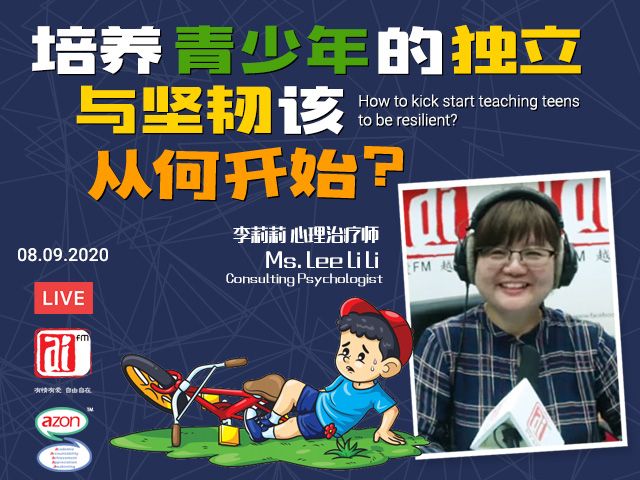 The founder and consultant psychologist of Azon, Ms. Lee Li Li, has been invited to share about "How to Kickstart Teaching Teens to be Resilient?" on Ai Ceria program by Ai FM on 8th September 2020 (Tuesday) at 10 a.m.
How to Kickstart Teaching Teens to be Resilient?
Independence and resilience are closely-knit. Before developing resilience, the child needs to first learn to be independent since young. However, parents tend to be worried about missing the golden opportunity of educating their child on independence and resiliency, especially when their child does not practice basic self-care, as their child grows into the teenage years. Nonetheless, according to the child developmental milestone, children have specific skills that are needed to be developed or trained in the different stages of life. In the teenage years, self-care skills should not be the main priority to develop independence, but parents ought to reflect on the reason behind the teenager's poor self-care ability (e.g. if my child does not have the habit to practice self-care, what can I do to cultivate the habit?). Utilise Peers' and Group's Influence to Guide Teens in Developing Independence and Self-Care Skills
In the process of cultivating the child's self-care ability, many parents tend to blindly apply the methods for young children (e.g. having a schedule for house chores) which are unsuitable and ineffective for teens. Other than sending their teens to live in hostels or boarding schools, parents also can periodically send their teens to live with a family that follows a strict routine, in which the environmental and peers' influence help to motivate positive self-care habits in the teen. At home, group (e.g. parents and siblings) influence can be utilised through a family day for house chores, in which following the concept of "walk the talk", family members work together to clean the home. It not only creates a pleasurable atmosphere of doing the house chores but also strengthens the parent-child relationships. Once the parent-child relationships have strengthened, naturally, the teens' attitude towards house matters will have a positive change. Resilience, Self-Confidence, and Flexibility
Other than independence, self-confidence, and flexibility play an important role in developing resilience in teens. In the teenage stage, compliments from parents may not be as effective as for a young child. Since cultivating self-confidence is a lifelong task, the methods to cultivate self-confidence also need to change according to the teen's development stage. In another perspective, the teenager's self-confidence increases from the acknowledgement of teachers, peers, or society. Hence, parents may consider allowing their teens to participate in curricular, extracurricular, or community activity to provide opportunities for teens to gain acknowledgement from different environments. Commonly, teenagers interact coldly with unfamiliar people, but express their warmth towards those who are close to them, such as having a poker face to the elders that they have not seen in years. In such situation, we can conclude that there is still room for improvement in the teen's self-resiliency. To be resilient, the teen should be able to handle gains and losses in life well (e.g. able to provide help to others, yet willing to receive help from others also). Parents are suggested to allow their teens to experience a wide range of life experiences instead of worrying about the dangers of the experience. The reason being, a similar event can have a different experience due to the different ways of handling the event under different environmental circumstances. This does not only cultivate teens' ability to look at an issue from multiple perspectives for problem solving, but also provides them the opportunities in life to attempt, adjust, and adapt.
Q&A
Q1: My 13-year-old son would do the house chores perfunctorily even though I have taught him to do it properly many times. He does not care about the quality of work and just doing it for the sake of finishing it. When the teen did not like the process of doing house chores, it is common to see them doing the task perfunctorily. It is suggested that parents should remind and give encouragement to the teen when they did great in some part of the task as a way to show concerns to them. At the same time, to improve the parents-teens relationship, parents should reflect on themselves whether they have set overly high expectations for the teens who are not detail-oriented enough to adjust accordingly.
Q2: My 11-year-old son dislikes doing house chores and would be angry if asked to do so. He thinks that chores are the adults' responsibility. However, it would be unfair to his other siblings if I don't let him do the house chores. What should I do?
Since the child has expressed his dislikes about the house chores, it is suggested that the parents should try to communicate more with him and find out the reason behind the behaviour.
Please click the following icons to watch or listen to the full sharing.


Note: The above content is adopted from the live sharing session on Ai Ceria program of Ai FM by Ms. Lee Li Li, titled "How to Kickstart Teaching Teens to be Resilient?" on 8th of September 2020 (Tuesday). Kindly contact our office if you would like to learn more or seek consultation. Thank you.
You may also like

AZON Broccoli of Care 2026
Date: 6–11 October 2026 Venue: Azon 生命教育学苑 Organising and Supporting Organisations: Azon Allied Health & Educare Development Life…
Read more
Love in Action · Parents and Children Together
Date: 23 July 2026 (Thursday) Venue: Persatuan Kebajikan Rumah Victory Malaysia – Elderly Home (Rumah Victory Elderly Home…
Read more
Love in Action: A Parent-Child Care Journey
Date: 23 July 2026 (Thursday) Venue: Rumah Victory Elderly Home, Puchong Registration Deadline: 18 July 2026 (Saturday) Dear…
Read more